Showing posts with label Victorian Era. Show all posts
Saturday, May 17, 2014
Monday, April 21, 2014
Friday, March 21, 2014
Tuesday, January 14, 2014
Victorian Ladies Playing the Piano with Longfellow Poem
THE SINGERS
God sent his Singers upon earthWith songs of sadness and of mirth,That they might touch the hearts of men,And bring them back to heaven again.
The first, a youth with soul of fire,Held in his hand a golden lyre;Through groves he wandered, and by streams,Playing the music of our dreams.
The second, with a bearded face,Stood singing in the market-place,And stirred with accents deep and loudThe hearts of all the listening crowd.
A gray old man, the third and last,Sang in cathedrals dim and vast,While the majestic organ rolledContrition from its mouths of gold.
And those who heard the Singers threeDisputed which the best might be;For still their music seemed to startDiscordant echoes in each heart.
But the great Master said, “I seeNo best in kind, but in degree;I gave a various gift to each,To charm, to strengthen and to teach.
“These are the three great chords of might,And he whose ear is tuned arightWill hear no discord in the three,But the most perfect harmony.”
~ Henry Wadsworth Longfellow
Monday, December 30, 2013
Happy New Year

"In the business and financial world the end of the old year marks a distinct epoch, and the first of January is the beginning of new accounts and new books. There is a general brushing up, so to speak, and a number of new rules enacted, even if they are never enforced.
There seems to be no reason why there should not be a moral brushing up, as well as a business one. On the first of January, why should not every one take an account of stock? Why not foot up all the good and bad done in the old year, and find out on which side the balance lies? If bad, it is a subject for correction; if good, it is a matter for congratulation.
It is not necessary for one to make the footings public, any more than a business man takes the outside world into his confidence, but a perusal may do a wonderful amount of good. Indeed, it is the only way by which one can learn to avoid a repetition of the errors of the old year.
The first of the new year is called "happy" doubtless on account of the good resolutions which inevitably spring from a contemplation of the past. It is the one day in the year when every right-minded person at least tries to do good, and it is an axiom that to be good is to be happy.
Another reason springs from the time-honored custom of calling and renewing old acquaintances, and thus reviving many happy memories.
Let no boy or girl be laughed out of making good resolutions on New Year's Day. To make a resolution and keep it for a single day is better than to make none at all, and it renders each successive resolution easier to make and keep. But good resolutions may be kept, and then, indeed, the new year will be a happy one.
Resolve, then, on New Year's Day to be something better and nobler than you have been in the old year, to correct some fault or develop some virtue; resolve to make some one's life brighter, or to do good in some way, however humble, and you will find your reward in a happiness equal if not superior to that which you have bestowed."
~ Excerpt from Golden Days for Boys and Girls, Circa. 1891
Victorian Home "Happy New Year" Clip Art, Drawing, Illustration
Saturday, November 30, 2013
Monday, September 23, 2013
Playing School
Sunday, August 25, 2013
Saturday, May 18, 2013
Victorian Fashion ~ May 1852
Figures 1 and 2.—Ball and Visiting Toilet.
May is here with its bursting buds and early flowers, but its fickleness overmatches that of its imitator, Fashion, and foils all her attempts at adaptation of costume for the carriage or the promenade. To-day the sun smiles as in leafy June; to-morrow cold, gray clouds lower upon the brow of the firmament, and chilling winds chase the zephyrs back to the orange groves of the South. To-day a light dress is seasonable; to-morrow a cloak might not be uncomfortable.
Fig. 3.—Visiting Dress.
Fig. 4.—Ball Toilet.
~ Excerpts from Harper's New Monthly Magazine, May 1852
Saturday, April 20, 2013
Victorian Fashion ~ April 1851
Fig. 1.—Promenade and Evening Costumes.
Like coquettish April, Fashion is now beginning to exchange its more sombre aspect for its sweetest smiles, and to develop its pretty flowers and delicate foliage. The darker colors and firmer textures of winter are now disappearing, and all the gay hues and lighter fabrics are taking their places.
—Bonnet.
—Straw Bonnet.
~ Excerpts from Harper's New Monthly Magazine, April 1851
Saturday, April 13, 2013
Tuesday, April 9, 2013
Old Fashioned Kitchen with Towel Rack
"The kitchen is a chemical laboratory, in which are conducted a number of chemical processes by which our food is converted from its crudest state to condition more suitable for digestion and nutrition, and made more agreeable to the palate."
~ Prof. Matthew Williams, 1800's
kitchen homemaking clip art of stove and towel drying rack
Friday, April 5, 2013
Mother Sitting With Children
“The career of motherhood and homemaking is beyond value and needs no justification.
Its importance is incalculable.”
~ Katherine Short
mother's day clip art with children
Monday, March 18, 2013
Victorian Fashion ~ March 1851
Fig. 1.—Morning and Evening Costumes.
Fig. 2.—Morning Costume.
Fig. 3.—Velvet Bonnet.
Fig. 4.—Ribbon Bonnet.
Fig. 5.—White Silk Bonnet.
Fashionable Colors are of deep and mellow hues; white predominates for evening use.
~ Excerpts from Harper's New Monthly Magazine, March 1851
Monday, February 18, 2013
Victorian Fashion ~ February 1851
Fig. 1.—Carriage and Morning Costumes.
Fig. 3.
Bonnets.—Those which are most worn this season are extremely open in front, as seen in figure 3, but close at the ears. They are moderately trimmed, consisting of rûches of lace, leaves and flowers of velvet, nÅ“uds of ribbon and velvet, and feathers. The interior is sometimes decorated in a fanciful manner, having garnitures composed of choux, or a bunch of ribbons of the same color as the bonnet, only in different shades: for example, a chou of green ribbon composed of the lightest shades, the bonnet of a very dark green. Most of the crowns are made of the jockey form, that is, round, but not plain, being generally covered with folds or fullings, according to the fancy and taste of the modiste. The curtain is now an important part of the bonnet, and requires great care in the placing, as it gives a very youthful appearance to the bonnet, if properly put on.
Fig. 4.
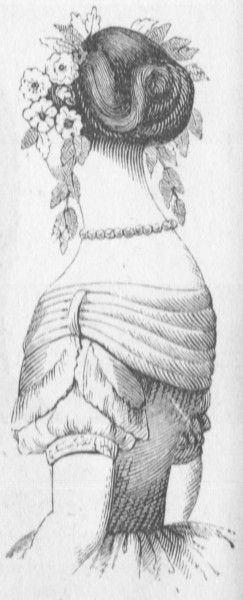
Head-dresses are now extremely rich and tasty in their appearance. Figure 4 shows a pretty style of coiffure for a miss, in a ball costume, the flowers being natural, if possible. Some of the latest novelties for head-dresses are those composed of gold ribbon, or silver and silk intermixed, the colors being of the finest character. Some are formed of long velvet leaves in shaded green, pink, and white; while others, of a grenat color, are sable and gold. Several pretty little head-dresses for home costume have appeared, composed entirely of shaded ribbon-velvets, or a square net-work of various colors, which have a novel and picturesque appearance.
Fashionable Colors are dark, rich, and full, such as grenat, narcarat, dark green, reddish brown, violet, and a reddish gray; while white, amber, purple, and pink predominate for evening dresses.
~ Excerpts from Harper's New Monthly Magazine, February 1851
Tuesday, February 5, 2013
Vintage Illustration ~ Reading to Children
I had a Mother who read me the things
That wholesome life to the boy heart brings-
Stories that stir with an upward touch.
Oh, that each mother of boys were such!
You may have tangible wealth untold;
Caskets of jewels and coffers of gold.
Richer than I you can never be --
I had a Mother who read to me."
~ Strickland Gillilan
Sunday, January 20, 2013
Gorgeous Home
“The best convent for a woman is the seclusion of her own home.
There she may find her vocation and fight her battles,
and there she may learn the reality and the earnestness of life.”
Wednesday, January 2, 2013
Saturday, December 8, 2012
Gorgeous Illustration of Victorian Girl in Winter
Winter Blanket
The snow is like a blanket that
God spreads across the land,
Where wheat and oats and barley sleep,
Awaiting God's command.
It covers all the pasture fields,
And hides the grasses brown:
It gives the bare, gray willow tree
A clinging, wooly gown.
It wraps around a fencepost tall,
And covers up its head,
Then drifts along the meadow banks
To tuck the creek in bed.
by Ada L. Wine
Subscribe to:
Posts (Atom)